1. Introduction: The Enterprise AI Paradox
Enterprises across every sector are pouring millions of dollars into foundational Large Language Models (LLMs), expecting revolutionary operational leaps. Instead, many find themselves trapped in an expensive paradox: soaring API bills, persistent model hallucinations, and negligible operational ROI.
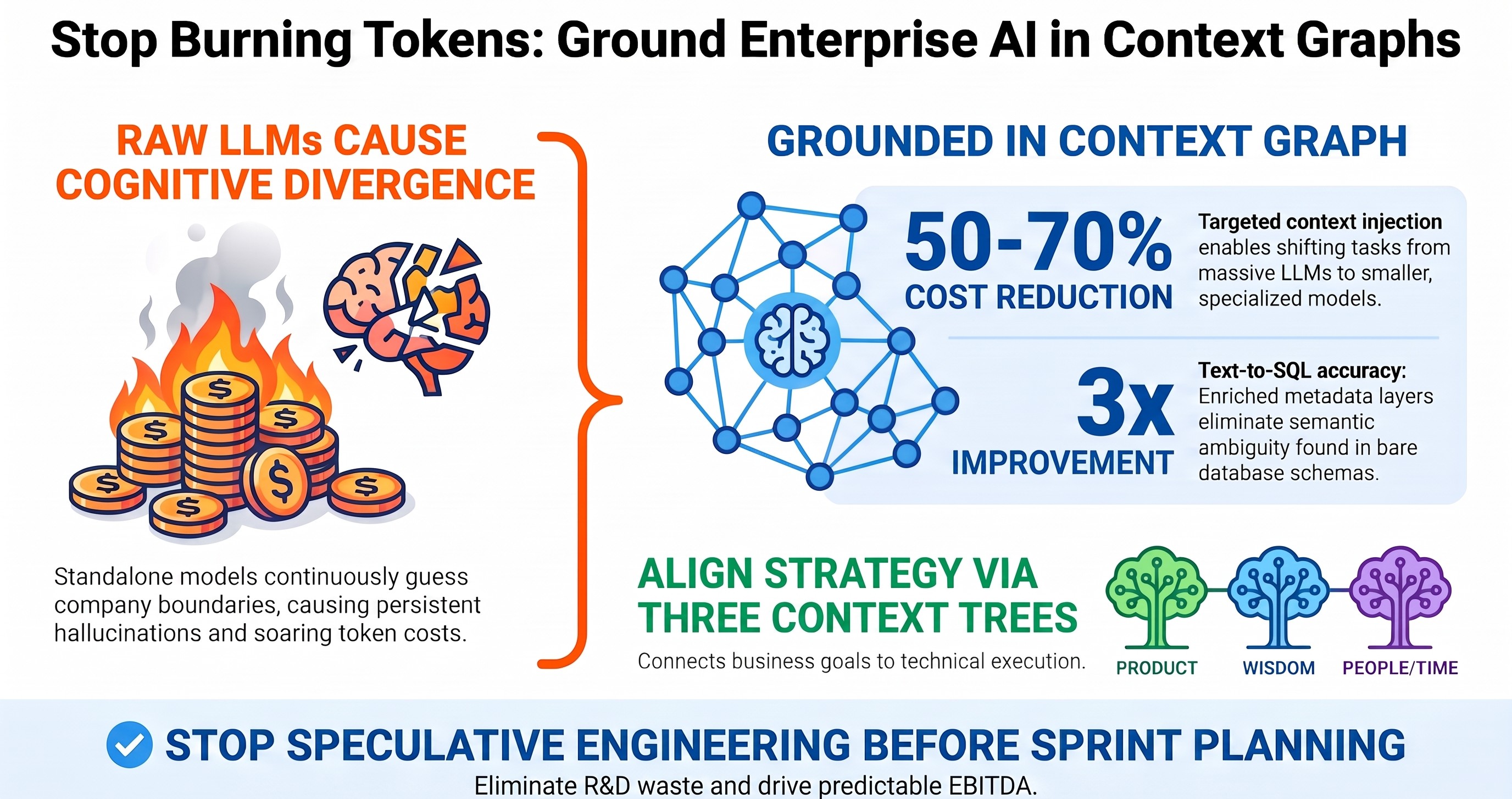
This breakdown occurs because raw cognitive capability has become a commoditized, off-the-shelf API. Modern enterprise AI projects do not fail due to a lack of computational intelligence; they fail because of "cognitive divergence." Standalone generalist models operate as probabilistic text predictors grounded in public internet data. When dropped into an enterprise, they must constantly guess at company-specific operational boundaries, business rules, and technical structures.
Relying on simple Retrieval-Augmented Generation (RAG) or bare database schemas is no longer enough to bridge this gap. To achieve true operational value, organizations must transition to a dynamic, persistent "Product-Centric Context Graph", a machine-readable model of enterprise relationships that grounds AI in exact organizational truth.
It addresses the most expensive question in enterprise software: What should we build next, why, and how?"
2. Models Are Commoditized, Context is Your Only True Moat
Standard LLM APIs put competitors on equal cognitive footing. Because any organization can access the same foundational models, the underlying model itself offers zero long-term defensibility or competitive differentiation.
When you deploy a standalone model, you pay for repetitive, long-context prompt injections just to brief generalist systems on baseline operational rules. In contrast, anchoring an AI system in a structured context layer provides immediate, deterministic alignment.
The difference between deploying a standalone model and one anchored in a structured knowledge network is analogous to hiring a brilliant consultant who has just walked through the door versus employing a veteran who has worked inside the organization for a decade.
The financial and operational impact of this structural alignment is immediate and quantifiable. Enterprise systems utilizing metadata-enriched context layers experience a 3x improvement in text-to-SQL generation accuracy compared to those querying bare database schemas, while vertical specialization and structured domain models yield a 25% to 40% improvement in execution accuracy on domain-specific tasks.
To evaluate this economic shift, enterprise AI financial return can be expressed through a formal utility framework: Rnet = R(Ct) + S(Ct) - Icap - Cvar(Ct)
In this framework, total net return (Rnet) scales through incremental revenue (R(Ct)) and operational savings (S(Ct)) against capital investments in semantic infrastructure (Icap) and variable inference costs (Cvar(Ct)).
By deploying a localized context graph, task routing can be shifted away from massive generalist LLMs to smaller, highly specialized models whose performance is elevated by targeted context injection. This structural shift reduces variable operational inference costs (Cvar) by 50% to 70%. Instead of treating AI as a depreciating operational expense driven by constant token burn, a context graph converts your deployment into an appreciating capital asset, a digital brain that grows richer with every transaction.
3. The "Hemingway Kirby Tail" Problem: Why Generic Vector Search Collapses
Traditional horizontal enterprise search and generic RAG architectures fail in complex, domain-specific environments because of structural flaws in how they handle data:
- The Bare Schema Bottleneck: Ingesting bare database schemas creates massive semantic ambiguity. For example, a financial database column labeled
arr_net(Annual Recurring Revenue Net of Churn, calculated on a fiscal year basis) differs fundamentally from a sales column labeledarr_recognized. Without machine-readable context definitions at inference time, an AI assistant makes probabilistic guesses generating valid SQL queries that yield catastrophically incorrect financial reporting. - Loss of Relational Context: Generic vector search shreds enterprise documents into isolated text chunks. This process destroys multi-hop, structural relationships across entities, rendering models incapable of resolving causal operational queries across systemic dependencies.
Consider the Hemingway Kirby Tail telemetry alert example: when an automated monitoring system flags a "Hemingway Kirby Tail P99 Latency" spike, a generic horizontal search engine queries internal wikis and vector indexes, returning irrelevant literary records about Ernest Hemingway or game design documents regarding Nintendo's Kirby character.
A product-centric domain context graph bypasses this noise entirely. By deterministically tracing structural relationships across codebases, active feature gates, streaming data pipelines, and service endpoints, the graph instantly connects the cryptic telemetry alert to its underlying reality: a severe latency regression on a gated streaming pipeline component that directly degrades downstream customer checkout metrics.
4. Aligning Business Wisdom to Code via the "Three Trees of Context"
A Product-Centric Domain Context Graph bridges the gap between high-level business strategy and technical execution through a framework known as the Three Trees of Context:
- The Product Tree: Maps the logical hierarchy of product development, tracing high-level corporate OKRs down to epic definitions, feature gates, codebase endpoints, and telemetry events.
- The Wisdom Tree: Serves as the repository of corporate intellect, explicitly tracking user signals, user research, synthesized learnings, strategic product decisions, and core design principles to preserve why choices were made.
- The People/Time Tree: Maps resource allocation, team ownership, decision drivers, cross-functional allocations, and scheduled release boundaries.
To process incoming market and customer inputs, the graph routes raw signals through a four-stage semantic trajectory called the Product Chain: Raw Signal → Generalized Learning → Product Decision → Binding Principle.
Driven by an OODA-loop (Observe-Orient-Decide-Act) processing framework, raw signals (such as support tickets or drop-off data) are synthesized by agents into generalized learnings, evaluated by human teams to make explicit product decisions, and codified into binding principles that govern downstream engineering tasks.
Unlike static file repositories, the graph explicitly distinguishes transactional facts from synthesized business logic:
| Raw Data Points (Facts) | Synthesized Business Logic (Learnings) |
|---|---|
| Examples: "Customer meeting held on Feb 12" "API response time registered at 240ms" | Examples: "Mid-market clients prioritize integrations over pricing" "Agent performance drops when code types are excluded" |
| Generation Cost: Low; easily extracted from transactional logs | Generation Cost: High; requires active cognitive synthesis |
| Cognitive Value: Tactical and highly specific | Cognitive Value: Strategic and highly generalizable |
| Systemic Impact: Answers narrow factual questions | Systemic Impact: Directly changes downstream system behavior |
| Lifespan: Highly volatile; ages rapidly | Lifespan: Semi-permanent; remains valid over long horizons |
5. Stopping "Speculative Engineering" with Strategic Merge Conflict Detection
The largest waste of capital in modern software organizations is "speculative engineering" writing secure, high-quality code for features that fail to solve real customer problems, violate system constraints, or contradict broader strategic directives.
Context graphs eliminate speculative engineering by detecting Strategic Merge Conflicts long before code execution or sprint planning begins. Just as developers use Git to manage overlapping code modifications, product teams use the context graph to catch overlapping strategic assumptions.
Rather than running full static analysis across massive codebases, the context graph anchors on known instrumentation elements feature gates, telemetry events, and experiment configurations and works outward. It maps request handlers, microservices, database endpoints, and software supply chain dependencies (both direct and transitive).
For example, a growth team might design an onboarding path optimized for rapid user sign-ups, while a security team simultaneously implements multi-step verification gates to mitigate sybil attacks on downstream databases. Because both initiatives map to the same downstream user metric, database endpoints, and feature gates, background auditing agents detect the logical collision automatically. The system flags the conflict and presents decision-makers with traceable, data-driven impact assessments before sprint cycles start.
6. Modern AI Needs Agentic Long-Term Memory, Not Amnesia
When independent operational agents act without a shared memory layer, agent collisions inevitably occur such as a marketing agent actively promoting a feature that an engineering agent just disabled due to database latency. Supporting cross-functional alignment and Product-Led Growth (PLG) requires persistent, structured agentic memory.
While traditional analytics monitor late-funnel conversions, a context graph tracks early-funnel behavioral patterns, capturing the 60% to 70% of hesitant consideration-phase visitors that standard tools miss. Grounding autonomous sales and support agents in this context achieves transaction conversion rates between 25% and 45%.
To sustain autonomous agentic loops safely, context graphs implement a comprehensive 9-part architectural memory framework. Key mechanisms include:
- Session Persistence: Maintains unconditional state storage surviving past execution loops, eliminating agent amnesia and preventing learning loops from starting at zero.
- Temporal Awareness: Incorporates semantic decay functions and real-time freshness evaluations to automatically flag stale, deprecated, or outdated business definitions.
- Active Conflict Detection: Employs logical validation engines that continuously map strategy bet overlaps, surfacing contradiction flags before code execution.
- Shared Symmetrical Access: Provides equal, symmetrical memory access for both human stakeholders and AI agents, building an appreciating corporate asset.
- Dynamic Delivery via Model Context Protocol (MCP): Uses MCP or targeted API context injection to deliver precise information at runtime, minimizing token waste and preventing context saturation.
Crucially, this architecture embeds essential governance and safety guardrails, including Human-in-the-Loop curation pipelines for verifying proposed facts and Full Traceability through granular versioning, author mapping, and source attribution metrics to maintain complete auditability.
Conclusion: Are You Building a Digital Brain or Just Burning Tokens?
Enterprise AI victory will not belong to the organizations with the largest LLM budgets. It will belong to those that make their internal business logic, operational strategy, and technical relationships machine-readable through dynamic, persistent domain context graphs.
By anchoring generalist models in localized organizational truth, you eliminate cognitive divergence, reduce variable token costs, and bind your engineering execution directly to business strategy.
Take a close look at your current AI deployments: Are you actively building an appreciating digital brain for your enterprise, or are you simply running expensive, probabilistic guesses?